


Nomad Electric is building one of the largest battery energy storage projects in Poland, a 150 MW / 300 MWh BESS in Jedwabno. On site, the system is taking shape fast – foundations are in, equipment is arriving, and what was recently an open field is turning into one of the country’s most significant pieces of grid infrastructure.
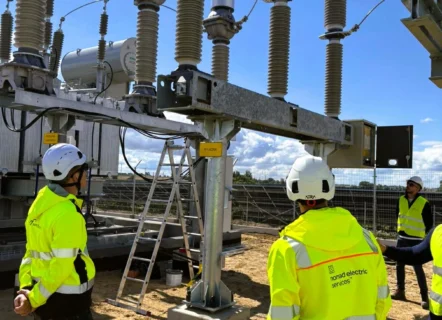
Our EPC scope covers the high-voltage substation and all of the supporting infrastructure needed to connect a project of this size safely and reliably to the grid. A battery system this large only delivers its full value if the connection around it like switchgear, protection, control systems, civil works, is engineered and built to the same standard.
Jedwabno matters beyond its own footprint. It directly supports Poland’s shift away from coal, and it helps stabilise a grid that increasingly needs exactly this kind of flexibility, a place to store surplus renewable generation when the sun is shining or the wind is blowing and to release it back when the system needs it most. As more solar and wind connect to the grid, projects like this are not a nice-to-have option but rather a precondition for keeping the lights on reliably, at the frequency and voltage the system was designed around.
Our CEO, Paweł Czaus, put the bigger picture into words recently: “The first chapter of the energy transition was about generation – scaling up renewables with solar leading the way. Now we’re entering chapter two, building an integrated system where storage and grid infrastructure catch up. At Nomad Electric, this is exactly what we do, we build and manage the critical infrastructure that makes it all work, from grids to hybrid plants. We’re moving from a world where renewables were a marginal add-on to one where they, backed by BESS and smart grid infrastructure, become a core, integrated part of the entire energy system.”
That shift from “add-on” to “core system” is exactly what we see happening at Jedwabno. A few years ago, a project like this would have been framed purely as a solar or wind story, with storage as an afterthought bolted on if the economics allowed it. Today, the storage and the grid connection are the project – the part that turns intermittent renewable output into something a grid operator can actually rely on, hour by hour, day by day.
Jedwabno is proving ground for how we deliver BESS infrastructure at scale. The same disciplines that go into a substation for a distribution operator, or SCADA for a wind farm, come together here in a single project, high-voltage engineering, civil works, electrical installation and the operational readiness to hand over a system that will run reliably for decades.
As chapter two of the energy transition unfolds across Poland, we expect more projects to look like Jedwabno rather than less – storage and grid infrastructure designed in from day one, not added after the fact. Nomad Electric intends to keep building exactly that kind of infrastructure, the unglamorous, essential backbone of the energy system itself.
read next

Never Stop
